

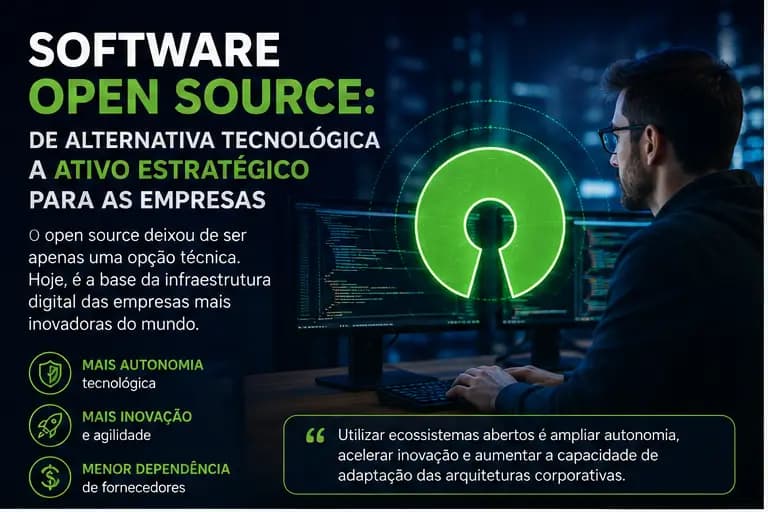
How the advance of open platforms, languages, runtimes and development tools is changing corporate technology strategy
Open source software has long ceased to be just an alternative used by developers and technical communities. Today, open source projects are present in virtually every layer of digital infrastructure, from operating systems and programming languages to databases, containers, cloud platforms, observability tools, artificial intelligence and development environments.
This evolution creates a new opportunity for companies: using open ecosystems not only to reduce licensing costs, but also to expand technology autonomy, accelerate innovation, reduce vendor dependency and increase the adaptability of corporate architectures.
The document that serves as the basis for this analysis highlights precisely the growing relevance of open source software and points to three strategic dimensions for executives:
technology sovereignty,
total cost and alternatives to closed platforms
.
The question, however, is not simply about replacing proprietary software with open software.
The real challenge is determining
where, when and how open source can generate competitive
advantage for the organization
.
The new role of open source in corporate infrastructure
For many years, corporate software adoption was concentrated in commercial platforms with licensing contracts, specialized support and update cycles controlled by the vendor.
The open source model introduced a different logic.
The code can be audited, modified, distributed and integrated with other components, according to the license used. This allows companies to build more flexible architectures and reduce dependence on a single platform.
This characteristic is especially relevant in cloud computing, data center and artificial intelligence environments, where the technology architecture can involve dozens or hundreds of different components.
A modern corporate environment can combine:
Linux; containers; Kubernetes; open source databases; languages such as Python, Go and Rust; JavaScript/TypeScript runtimes; open APIs; observability tools; CI/CD platforms; messaging systems; artificial intelligence frameworks; security tools; distributed storage solutions.
The result is a technology ecosystem in which open source ceases to be an isolated component and starts to function as
a structural layer of digital infrastructure.
Technology sovereignty gains importance
One of the most relevant aspects of open source for large organizations is technology sovereignty.
In a proprietary environment, a company can depend on the commercial, technical or strategic decisions of a vendor.
Price changes, licensing changes, product discontinuation, roadmap changes or acquisition of the supplier company can directly affect the customer's technology strategy.
With open source, the situation can be different.
Even when a company depends on an organization responsible for developing a given project, open code offers greater possibility of inspection, adaptation and migration.
This does not eliminate the risk of dependency.
An open source project can depend heavily on its maintainers, a foundation, a sponsoring company or a specific community.
Therefore, technology sovereignty does not simply mean using open source software.
It means having
real capacity to understand, operate, maintain and, when necessary, replace
critical architecture components.
The real cost is not just in the license
Another fundamental point is the total cost of ownership.
One of the greatest advantages attributed to open source is the absence or reduction of licensing costs. However, a mature business analysis needs to consider all cost components.
Among them:
deployment; integration; infrastructure; training; support; maintenance; updates; security; monitoring; availability of professionals; development of customizations; migration; operating costs; vulnerability management.
Therefore, free software does not necessarily mean low-cost software.
An open source platform can have virtually zero license cost, but require a specialized team for operation and maintenance.
Likewise, a commercial solution can have a high licensing cost, but offer support, updates and management tools that reduce operating costs.
The decision needs to be based on TCO — Total Cost of Ownership — and not just the initial price.
The case of modern languages and runtimes
The evolution of programming languages demonstrates how open source is also directly influencing software engineering.
Rust is an important example.
The language was designed with a strong focus on memory safety and performance, characteristics especially relevant for infrastructure systems, low-level software and applications that require computational efficiency.
The base material cites the article "Branchless Rust: Making a Filter 4x Faster by Removing an If", placing software optimization as one of the relevant signals to track.
The case is interesting because it demonstrates an important shift in modern engineering: performance does not depend exclusively on increasing computational capacity.
Optimizations in the code can also reduce CPU consumption, improve latency and increase throughput.
In large-scale environments, small efficiency improvements can represent significant impacts.
If an application processes millions of operations per second, a reduction in CPU cycles per operation can result in:
lower server utilization; reduced energy consumption; fewer infrastructure expansion needs; greater capacity per server; reduced operating costs.
This line of reasoning is especially important for data centers that run high-density workloads.
Deno and the evolution of runtimes
Another important aspect of the open source ecosystem is the evolution of runtimes.
Deno, for example, is officially presented as a modern runtime for JavaScript, TypeScript and WebAssembly, built on V8, Rust and Tokio. The project adopts security-by-default principles and offers integrated development tools.
This type of architecture demonstrates how different open source projects can be combined.
JavaScript and TypeScript can act on the application layer, while Rust provides high-performance components, and the runtime uses execution technologies developed in other open source projects.
The consequence is a highly integrated technology chain.
The Deno project itself demonstrates continuous evolution in areas such as Node.js compatibility, npm support, compilation, observability and performance.
For companies, this reinforces the importance of evaluating not only the popularity of a tool, but also its
maturity, community, update frequency, security and integration
capability.
Open source and artificial intelligence
The expansion of artificial intelligence has further increased the importance of open source software.
Frameworks, libraries, models, inference tools, orchestration systems and infrastructure components are often developed openly or made available under different licensing models.
This architecture allows companies to build more flexible AI environments.
A corporate AI platform can involve:
Data layer: data lake; relational databases; vector databases; ingestion pipelines; governance systems.
Model layer
proprietary models; open source models; specialized models; multimodal systems.
Execution layer
GPUs; CPUs; specialized accelerators; containers; orchestration.
Application layer
APIs; agents; search systems; automations; corporate applications.
Security layer
identity control; access management; encryption; observability; audit.
In this scenario, the use of open source components can allow greater control over the architecture and facilitate the replacement of certain vendors.
The challenge of dependencies
However, open architectures also bring challenges.
A modern application can depend on dozens or hundreds of libraries.
Each dependency represents a potential risk surface.
A vulnerability in a low-level library can affect applications that use that library indirectly.
Therefore, companies need to adopt practices such as:
Software Composition Analysis (SCA); component inventory; SBOM — Software Bill of Materials; version control; vulnerability analysis; artifact signing; integrity verification; update policies;
dependency monitoring.
Open source security should not be analyzed only by looking at the main code of the application.
It is necessary to know
the entire software supply chain.
Governance becomes indispensable
The base document draws attention to the risks of hasty adoption and the need for governance.
This point is particularly relevant for large organizations.
Before incorporating an open source project into a critical application, the company should evaluate:
Licensing
It is necessary to understand the obligations associated with the license used by the project.
Not all open source software has the same conditions of use, distribution and modification.
Maturity
Recent projects may have great potential, but may not yet have enough stability for critical workloads.
Community
An active community can indicate greater capacity for maintenance, vulnerability fixes and evolution.
Security
It is necessary to verify the vulnerability history, the fix process and development practices.
Dependence on maintainers
Projects maintained by few developers may present greater operational risk.
Roadmap
It is important to assess whether the project's evolution is aligned with the organization's future needs.
The importance of benchmarks
The document also presents a reference to the debate on Goodhart's Law applied to benchmarks.
This concept is extremely relevant for technology decisions.
A metric can be useful for comparing solutions, but it can stop adequately representing the objective when it starts to be treated as an absolute goal.
For example, choosing a technology solely because it has higher throughput in a specific benchmark can produce a wrong decision.
A platform can have excellent synthetic performance, but have:
greater operational complexity; lower availability of professionals; more difficult integration; higher support costs; observability problems; security limitations.
Therefore, benchmarks need to be used together with business and operations metrics.
How to evaluate an open source solution
A corporate methodology can consider at least eight dimensions:
Dimension
Strategic question
Performance
Does the solution meet the load and latency requirements?
Security
How are vulnerabilities identified and fixed?
License
Is the licensing model compatible with corporate use?
Community
Is there an active and sustainable community?
Maturity
Is the technology ready for production?
TCO
What is the total cost of operation?
Integration
How does it connect to the current environment?
Strategy
Does the technology contribute to the company's future goals?
This analysis reduces the risk of decisions based exclusively on popularity or technological enthusiasm.
The impact for CIOs and CTOs
The expansion of open source also changes the role of technology executives.
CIOs and CTOs need to balance three objectives:
innovation, to keep up with new technologies; control, to manage risks and costs; autonomy, to avoid excessive strategic dependencies.
This equation becomes even more complex when open source software, cloud and artificial intelligence come together.
A company can, for example, use open source components to build an internal platform and, at the same time, run part of the workloads on a public cloud.
This can create flexibility, but also requires well-planned architecture.
The organization needs to know which components can be migrated, which depend on specific services and what the cost of a possible vendor change would be.
Open source as a multicloud strategy
One of the most interesting applications of open source is building architectures less dependent on a single cloud platform.
Containers, Kubernetes, open APIs, independent databases and observability tools can facilitate the portability of certain workloads.
This does not mean that any application will automatically be portable.
Managed cloud services often incorporate specific features that increase productivity, but can also increase lock-in.
The strategic decision consists of determining
where portability is really important and where the
use of proprietary services offers enough advantage to justify the dependency.
What changes for companies
The impact of open source can be divided into four major areas.
Infrastructure
Greater flexibility in building hybrid, private and multicloud environments.
Product
Possibility of incorporating emerging technologies with greater speed.
Operation
Need to develop internal capabilities to manage critical components.
Governance
Greater responsibility for security, licensing, dependencies and lifecycle.
The base document synthesizes this change by highlighting impacts on infrastructure, product and operation, in addition to the risks related to hasty adoption.
How to turn a trend into competitive advantage
The central recommendation is not to adopt more open source software.
It is to adopt it better.
The first step should be to identify concrete problems.
Next, select technologies that can be evaluated on a small scale.
The document recommends exactly this approach: small experiments, with clear success and risk criteria.
A corporate program can follow this flow:
Identify the business problem.
Define success indicators.
Select technology alternatives.
Assess security and licensing.
Run a pilot.
Measure performance and TCO.
Assess operational risks.
Decide on adoption, adaptation or discard.
Scale only after validation.
This approach allows experimentation without turning every new technology into a structural change in the corporate environment.
Will the future necessarily be open source?
No.
The future will probably be hybrid.
Companies will continue to use proprietary software, managed services and commercial platforms together with open source components.
The strategic question will be to determine
which layer should remain under the direct control of the
organization and on which layers it is worth using specialized third-party services
.
In certain cases, a proprietary solution can offer better performance, support or integration.
In others, an open source alternative can offer greater flexibility and autonomy.
The competitive advantage will lie in the ability to make this decision objectively.
Conclusion
Open source software has definitively entered the strategic agenda of organizations.
Its relevance is not only in the possibility of reducing licensing costs, but in the ability to create more flexible architectures, stimulate innovation, expand technology sovereignty and reduce certain forms of vendor dependency.
At the same time, adoption requires maturity.
Security, licensing, governance, maintenance, dependencies, availability of professionals and total cost need to be part of the decision.
The current scenario also demonstrates that open source and artificial intelligence are increasingly connected, creating new possibilities for developing applications, infrastructure and digital services.
For technology leaders, the question is no longer whether open source should be part of the strategy.
The question now is:
which architecture components should be open, which should be proprietary, and how can this combination generate more innovation, autonomy and efficiency for the business?
The answer will have to be built with data, experimentation and metrics.
As the base document highlights, tracking technical discussion, tool maturity and real cases is essential for turning market signals into small, measurable experiments.
FAQ
Why does open source software matter now?
Because the open source ecosystem is present in several layers of digital infrastructure and can impact product, infrastructure, costs, security and competitiveness. The base document also highlights the increase in technical discussion and engagement signals around the topic.
Does open source mean free software?
Not necessarily. The code may be available without license cost, but deployment, support, maintenance, security, infrastructure and specialized labor can represent significant costs.
Is open source more secure than proprietary software?
There is no universal answer. The level of security depends on the project, its community, the development process, the speed of vulnerability fixing and how the company integrates and operates the software.
How should a company start?
By defining a business problem, selecting an appropriate project and running a controlled pilot. The document recommends a short timeline and objective metrics for cost, quality and delivery time.
Does open source eliminate vendor lock-in?
Not necessarily. It can reduce certain forms of dependency, but open source projects can also create dependencies on communities, support providers, specialized professionals or specific components.
What is the main caution for executives?
Avoiding decisions based only on popularity, isolated benchmarks or technological enthusiasm. Technology should be evaluated together with security, TCO, governance, maturity, integration and business strategy.